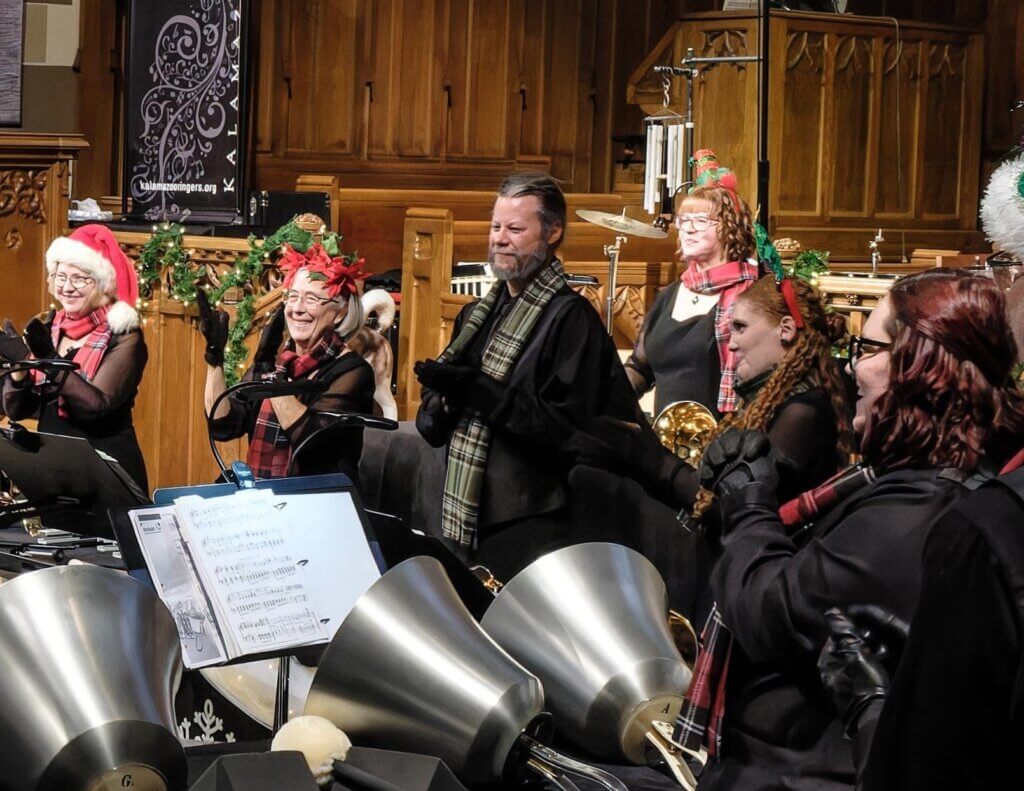
Deck the Halls is a traditional carol with a Welsh tune that dates back to the 16th century. The original Nos Galan drinking song was part of the New Year’s Eve celebrations in Wales, and the lyrics had nothing to do with Christmas, and more to do with drinking!
“Deck the hall with boughs of holly, Fa, la, la, la, la, la, la, la, la! ‘Tis the season to be jolly: Fa, la, la, la, la, la, la, la, la! Fill the meadcup, drain the barrel, Fa, la, la, la, la, la, la, la, la! Troul the ancient Christmas carol. Fa, la, la, la, la, la, la, la, la!”
The English lyrics were written in 1862 by Scottish musician Thomas Oliphant. Over the years, the words have changed even more, with the drinking references gone in the later versions.
In case you’re wondering about the “correctness” of the title, Deck the Hall (singular) was used in the original English version. Our late friend Tim Waugh was always insistent that only one hall should be involved. However, the plural “halls” has been widely used since the late 1800s, so we believe that either version is acceptable. Our 12-bell arrangement only has the melody and not the lyrics, so if you want to change the title and call it Deck the Hall, that’s no problem at all.
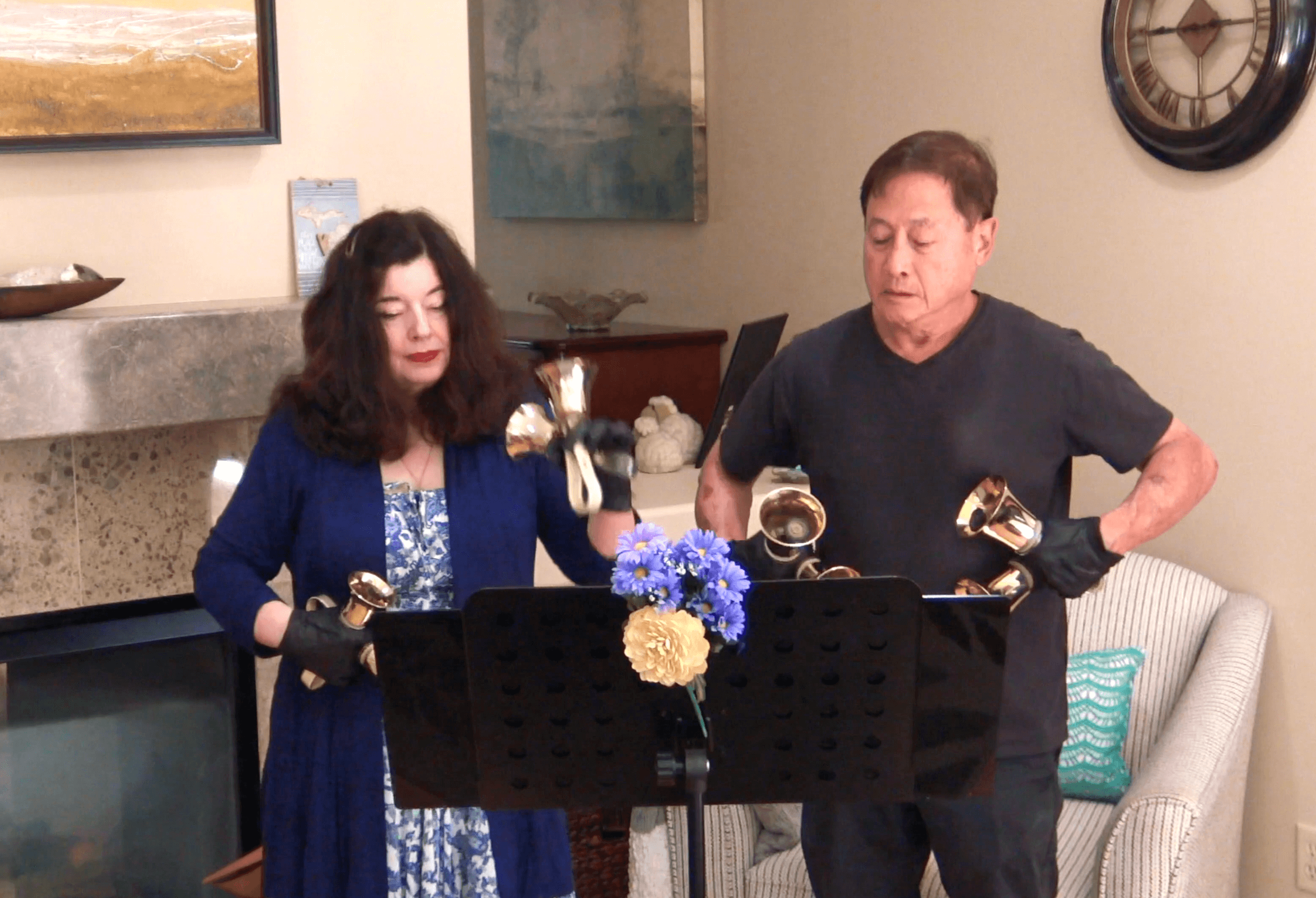
Here’s our demonstration video, recorded on a sunny afternoon in July:
More information about Deck the Halls
As with all Choraegus 12-bell pieces, Deck the Halls is suitable for 3-6 ringers. Sheet music for this arrangement is available to purchase and download from Choraegus. Each arrangement is available for three different ranges of handbells, so you can choose which you prefer. Please refer to the bells-used charts on the Choraegus webpage to make sure you have all the bells you need, and make sure you purchase the right version!
We also have an 8-bell arrangement of Deck the Halls, available to download from Choraegus.
Important things to know about Choraegus handbell music
Choraegus handbell music scores are designed to be downloaded as PDF files. That means you’ll be responsible for printing your own music, and you won’t receive anything in the mail. Purchasing a 12-bell arrangement gives you permission to print and maintain up to six copies for your handbell group – so please don’t pay for more copies than you need! A practice track is also available separately – useful if your ringers need to practise their parts without the full group being available.
Your purchase also gives permission for performance, broadcasting, live-streaming and video-sharing online. See our licensing agreement for full details. Please remember to mention the arranger (Larry Sue) and the publisher of the piece(Choraegus) on video-sharing sites, social media and any printed materials such as concert programs. We appreciate your help in getting the word out about Choraegus handbell music – and if you make a video of your handbell group playing any of our pieces, we’d love to see it!
If you haven’t purchased music online from Choraegus before, you might like to look at our step-by-step guide. We designed this to help you navigate the purchase and download process in a (we hope!) stress-free way.
Any questions?
If you have any questions about our music, please start by reading our Frequently-Asked Questions. Please contact us if you don’t find the answers you need, and we’ll be happy to help!
Infant Holy, Infant Lowly is a traditional Polish Christmas carol. The song was originally titled W Żłobie Leży (In the Manger He Lies), and it was translated into English as Infant Holy, Infant Lowly in 1920. It’s thought that the melody could date back to the thirteenth century.
“Infant holy, infant lowly, For His bed a cattle stall. Oxen lowing, little knowing, Christ the Babe is Lord of all. Swift are winging, angels singing, Noels ringing, tidings bringing, Christ the babe is Lord of all.”
We recorded our demonstration video on a hot day in July. If you use your imagination, you might think that the harsh sunlight on the trees and grass behind us is soft, billowing snow. If not, it can just be a Christmas in July thing. After all, if we waited until December to publish new handbell music, no one would have time to learn it!
More information about Infant Holy, Infant Lowly
As with all Choraegus 12-bell pieces, Infant Holy, Infant Lowly is suitable for 3-6 ringers. Sheet music for this arrangement is available to purchase and download from Choraegus. Each arrangement is available for three different ranges of handbells, so you can choose which you prefer. Please refer to the bells-used charts on the Choraegus webpage to make sure you have all the bells you need, and make sure you purchase the right version!
We have other arrangements of Infant Holy, Infant Lowly, available to download from Choraegus. We have two 8-bell versions; one standard and one Surprisingly Easy™. We also have a Level 2 arrangement for 3 octaves.
Things to know about Choraegus handbell music
Choraegus handbell music scores are designed to be downloaded as PDF files. That means you’ll be responsible for printing your own music, and you won’t receive anything in the mail. Purchasing a 12-bell arrangement gives you permission to print and maintain up to six copies for your handbell group – so please don’t pay for more copies than you need! A practice track is also available separately – useful if your ringers need to practise their parts without the full group being available.
Your purchase also gives permission for performance, broadcasting, live-streaming and video-sharing online. See our licensing agreement for full details. Please remember to mention the arranger (Larry Sue) and the publisher of the piece(Choraegus) on video-sharing sites, social media and any printed materials such as concert programs. We appreciate your help in getting the word out about Choraegus handbell music – and if you make a video of your handbell choir playing any of our pieces, we’d love to see it!
If you haven’t purchased music online from Choraegus before, you might like to look at our step-by-step guide. We designed this to help you navigate the purchase and download process in a (we hope!) stress-free way.
Any questions?
If you have any questions about our music, please start by reading our Frequently-Asked Questions. Please contact us if you don’t find the answers you need, and we’ll be happy to help!
Not-collecting chickens has become an important part of our life in the last couple of years! If you’ve ever looked at our Facebook page on a Tuesday, and wondered why on earth there are so many posts about chickens, and no posts about our handbell music, we’ll explain it here.
How the whole chicken adventure started
In October 2019, we bought our sweet little Victorian cottage at Bay View, in northern Michigan. As is usual with cottage sales at the Bay View Association, the previous owner included some furniture and other items in the sale. One of these items, left on a shelf in the kitchen, was a chicken.
The random chicken that started it all
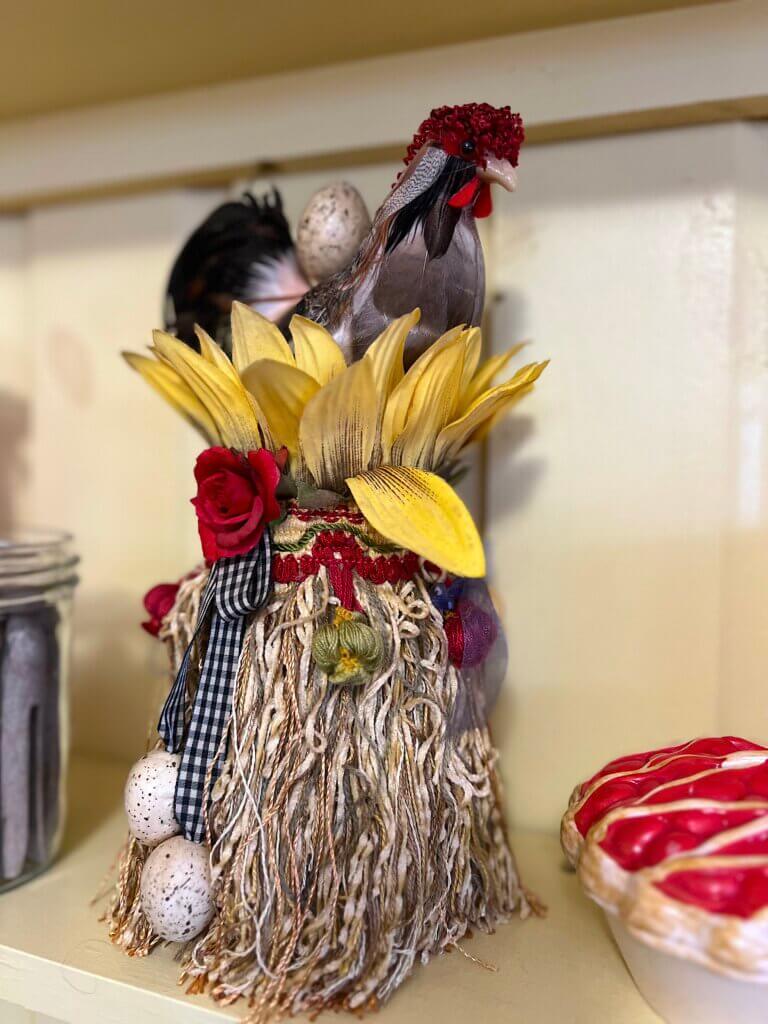
This sweet chicken seemed lonely, as the only chicken in our kitchen. The top of the microwave looked vast and empty, so we bought a red chicken with white spots to go on top of it. Then that chicken clearly needed a friend. During a romantic stroll around our local HomeGoods, we saw a white chicken that looked like the perfect companion to sit on the microwave. And so it continued. Before we knew it, we had chickens in our cottage. Not a lot of chickens, but definitely some.
Actual collectors of chickens
In this world, it is well known that some people are actual collectors of chickens. Some people collect coins, stamps, hippos, porcelain dolls, owls, or other random things. Some people collect chickens. They are happy and proud to be actual collectors of chickens. They have shelves in their homes, for the chickens, and they eagerly search for chickens in antiques stores and thrift shops, to increase their collection. Some people specialize in collecting a particular kind of chicken – like ceramic chickens, for example, or chicken kitchenware.
Actual collectors of real, live chickens
Some people like to collect real, live chickens. Backyard chickens are a big thing these days, and social media is full of photos and videos of happy people with their chickens. They sit outside and watch their chickens, they collect eggs, and they post videos of their chickens doing amusing things during the day. It’s a good life, if that’s what you want to do.
It’s a slippery slope
Collecting chickens can be a slippery slope. You can find chickens everywhere. They’re in antiques stores, thrift shops and grocery stores. You find them in art galleries and gift shops, and even at farmers’ markets and museums. The chickens that are available for purchase can be very tempting. You buy one or two chickens, and yes, they’re sweet. Family members start giving you chicken-items for birthdays and Christmas, and the chickens start to pile up in your home. You put up a couple more shelves, or replace your cute little accent cabinet with a much taller cupboard that has more space inside. Before you know it, you’re renting a storage unit on the edge of town, and then you have to move into it, because the chickens have completely taken over your home, and your kids aren’t talking to you any more, out of fear that they’ll inherit them all.
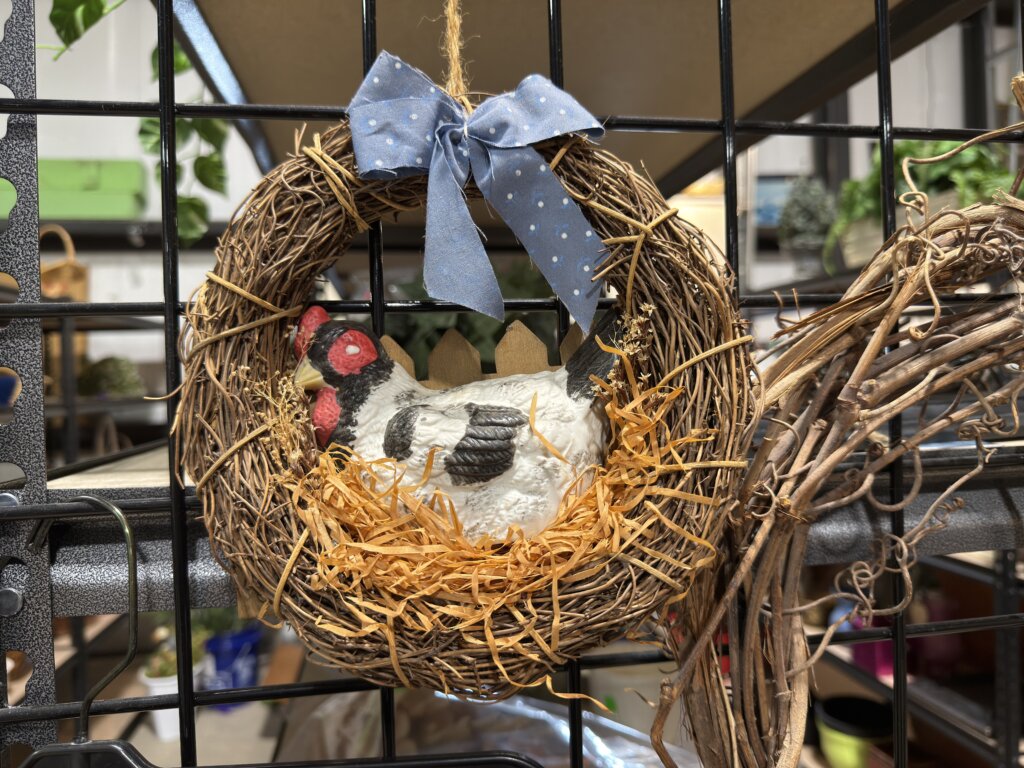
A vintage chicken wreath, seen at New Beginnings Resale in Harbor Springs, Michigan
Why we started not-collecting chickens
We reached a point where people were starting to think that we were collecting chickens. That was understandable, because we’d shared photos of some of our chickens on social media. However, we definitely didn’t want to become actual collectors of chickens. We decided to prove that we weren’t, by taking photos of all the chickens we saw, but didn’t collect. This would be the evidence that we were officially not collecting chickens. We added the all-important hyphen, and it became known as Not-Collecting Chickens. It’s even a hashtag on Facebook now – #NotCollectingChickens. Hyphens don’t work with hashtags, of course, so you just have to remember that it’s there in secret.
How to not-collect a chicken
See a chicken as you go about your daily life. This could be a real, live chicken, or it could be some other kind of chicken. Not a food-chicken, but perhaps a carved, wooden chicken, or a metal chicken, or a ceramic chicken, a chicken mug, or a chicken on a t-shirt. You get the idea. There are not-collectable chickens everywhere.
Take a photo of the chicken. Don’t take the chicken home with you. Note that it’s helpful if you don’t pick up the chicken and start to bond with it. Admiring the cuteness is fine, but once you start to imagine where the chicken could sit in your living room, you’re running the risk of turning into an actual collector of chickens. It’s entirely up to you, but do you really need chickens?
Send the photo to us for the not-collection. You can post it on our Facebook page, or click on the message button to send it privately if you don’t want to risk other people seeing it before we do.
Congratulations! You have successfully not-collected a chicken! Now find some more!
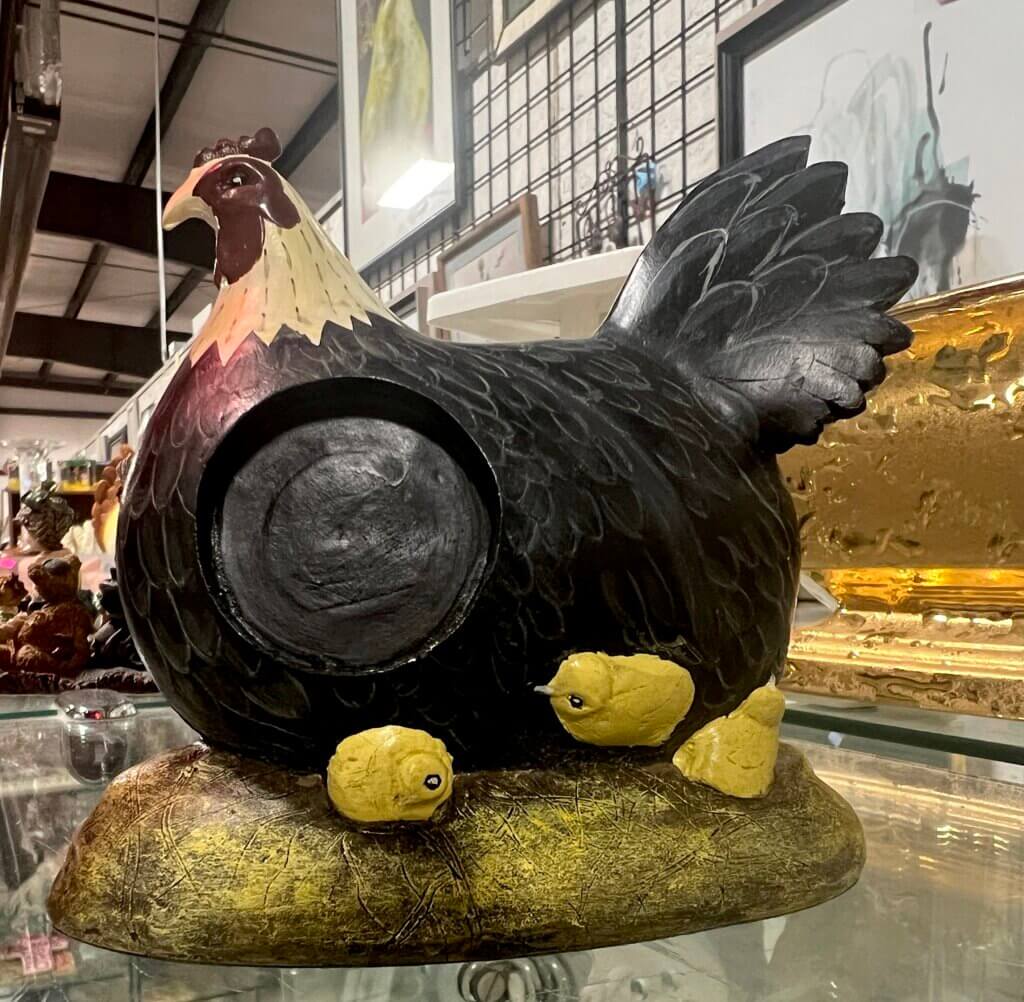
A beautiful not-collectable chicken, complete with underage chickens
Why is the hyphen so important?
If you think about it, there’s a big difference between not collecting chickens, and not-collecting chickens. There are lots of people who don’t collect chickens, after all. They don’t even think about chickens. They don’t look for them in thrift stores, and they don’t yell “CHICKEN!” as they drive past one in someone’s back yard, then turn around and go back to take a photo of it. You can ask someone if they collect chickens, and they’ll reply that no, they don’t collect chickens (unless they do, of course).
The art of not-collecting chickens is a more deliberate thing. You have to take a photo of the chicken, for a start, as proof of the successful not-collection! That’s why the hyphen matters. It’s the difference between simply not collecting chickens, and actively seeking out chickens to not-collect, and not-collecting them by taking the photo without taking the chicken home.
Extreme temptation
Some chickens are very tempting. You’ll see them in the thrift stores and gift shops, and you’ll love the cuteness of them, and their sweet little head-thingies and underbeak dangly bits! They might have soft wings, or fluffy little underage chickens with them. The choice is always yours. If you are catastrophically tempted by a chicken, and you end up taking it home, don’t panic.
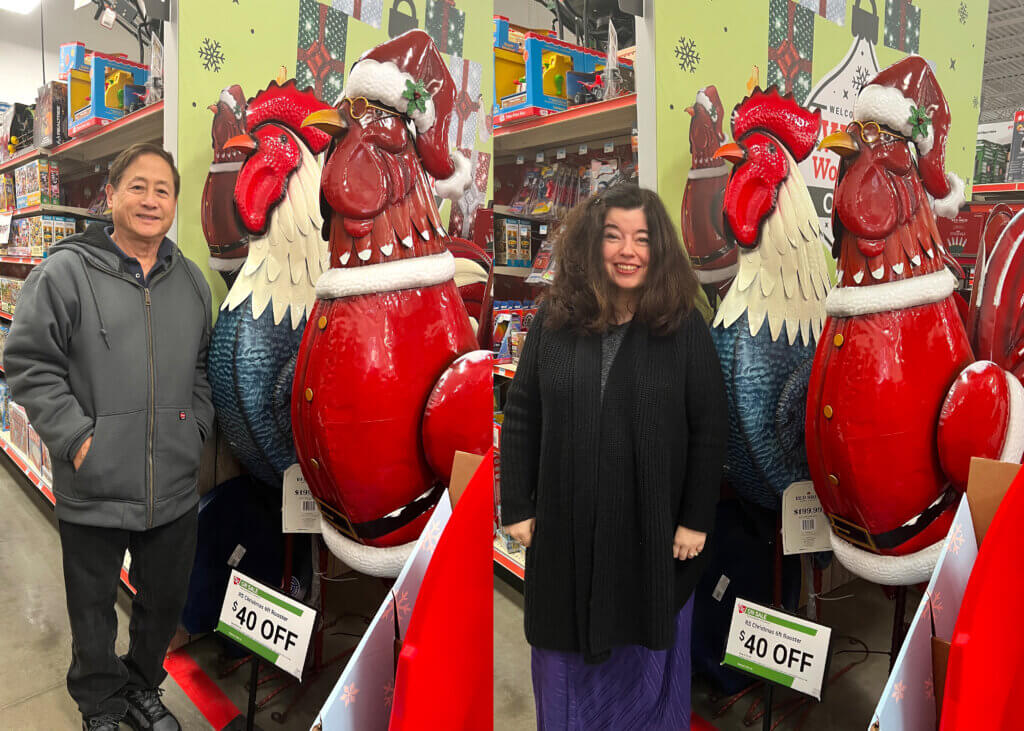
The photo below shows us being seriously tempted by MASSIVE RED CHRISTMAS CHICKENS in our local Tractor Supply place. We were able to not-collect these successfully, but it wasn’t easy. We were quite obsessed with these MASSIVE RED CHRISTMAS CHICKENS for a while. Are we over them now? Well, no. We still don’t have one on our porch, though. Sometimes the number on the price tag helps to make a chicken more not-collectable.
Occasional adoption doesn’t count as collecting
There are definitely some situations where it’s okay to take a chicken home with you. There is no need for guilt at this point. Occasional adoption doesn’t count as collecting. It’s a totally different thing. There are also several other situations where taking a chicken home won’t turn you into an actual collector of chickens:
When a chicken is a gift. If someone gives you a chicken (even if they say, “I know you collect chickens!”), it’s okay to take the chicken, and it totally won’t count as collecting. It would be very rude to tell someone that you don’t want a chicken, especially as it might be a very nice chicken. Take the chicken, adopt it into your home, and send us a photo of it for our not-collection. Even if someone thinks YOU are an actual collector of chickens, WE are definitely not.
When a chicken is handmade. If you make a chicken, that definitely shouldn’t count as collecting. If you have crochet skills, or you know how to knit a chicken, it’s perfectly acceptable to create a chicken and keep it in your home. Even if you made one out of a paper plate, it still wouldn’t count as collecting if you decided to keep it.
When a chicken is handmade and is a gift. If someone gives you a chicken that they’ve made themselves, that also would not count as collecting. To be given a handmade chicken is a very special thing, and no one should ever say no-thank-you to a handmade chicken. Think of the love and time that went into creating that chicken!
When it’s an Emotional Support Chicken. We’ve probably all seen Emotional Support Chickens. They’re usually crocheted or knitted, and they look very sweet and emotionally supportive. If you have an Emotional Support Chicken, we’re pretty sure that it’s illegal for anyone to suggest that you’re an actual collector of chickens. That chicken is providing a vital service for your mental and emotional health, and that definitely doesn’t make you an actual collector of chickens!
When you inherit a chicken. Inheriting a chicken is a very special privilege. It definitely doesn’t count as collecting. Even if you inherit someone’s entire chicken collection, you can still claim it as an occasional adoption situation. Just don’t add to it. You know the risks. Storage units are expensive.
When you have struggled with temptation, and you already love the chicken. Chickens need homes. If you are overcome by temptation in the antiques store, you can purchase the chicken if you really want to, and it will just count as an occasional adoption situation. Adopt the chicken, take it to your home, and resolve to not-collect the next one you see. Repeat as many times as you need to.
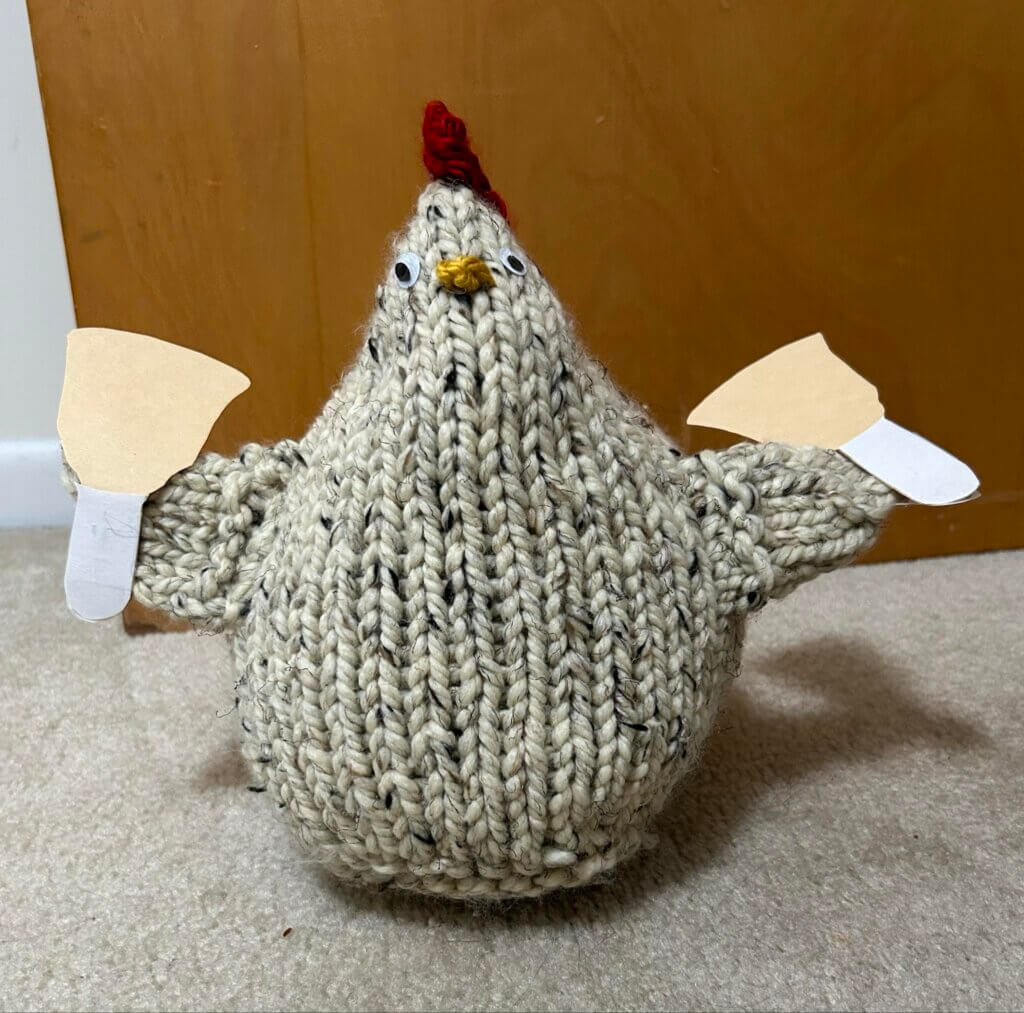
Our friend Eileen knitted a chicken (Poppy), and gave her some wingbells to play!
Chicken Tuesday
Chicken Tuesday now has its own hashtag on Facebook! If you go to our Facebook page, and it happens to be a Tuesday, you’ll see photos of chickens, videos of chickens, news stories about chickens, and chicken crafts. Larry might even be wearing a chicken t-shirt. Best of all, Chicken Tuesday is when we share the photos of the chickens that we and our friends have not-collected in recent weeks! We have several Facebook albums filled with not-collected chickens now, and we add to the not-collection every week.
We know that some people talk about tacos on Tuesday, but that’s not a thing for us.
Chicken of the Week
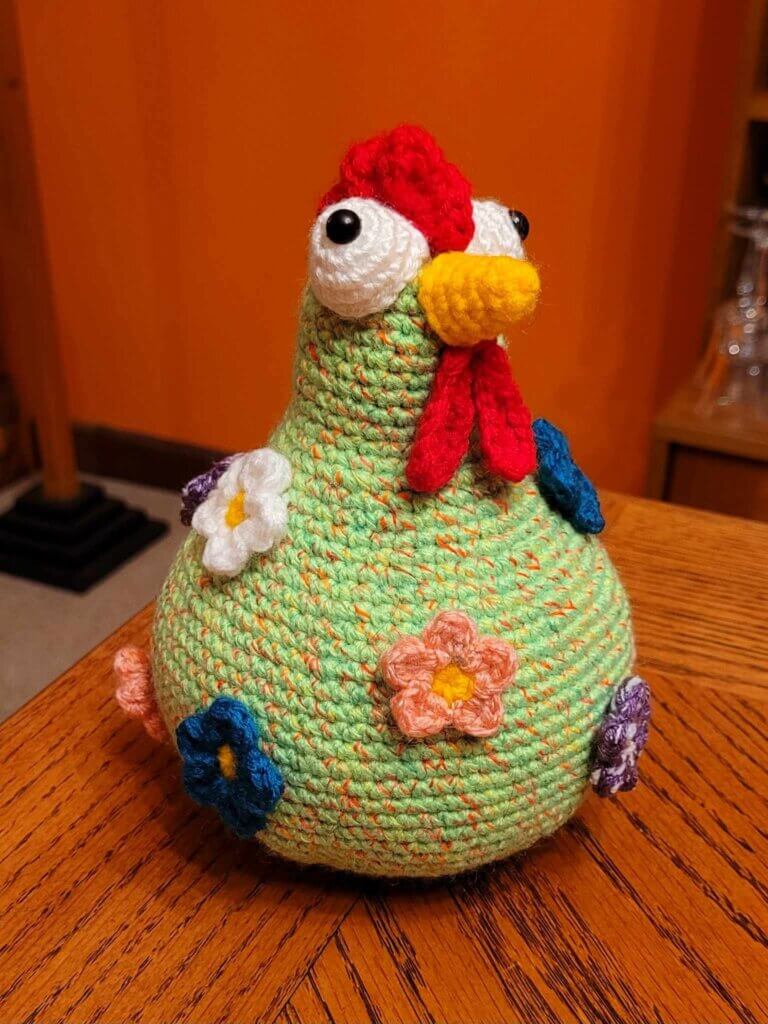
On Tuesdays, if there is a particularly special chicken, that chicken will get the Chicken of the Week award! There are no prizes if your chicken is chosen to be Chicken of the Week, but it’s exciting anyway! We have to admit that chickens chosen for this special award are often handmade, by people with knitting or crochet skills. Eileen’s chicken in the photo above was a recipient of the Chicken of the Week award, for example. Here is another:
A beautiful crocheted chicken, made by Rachel
Not-chickens
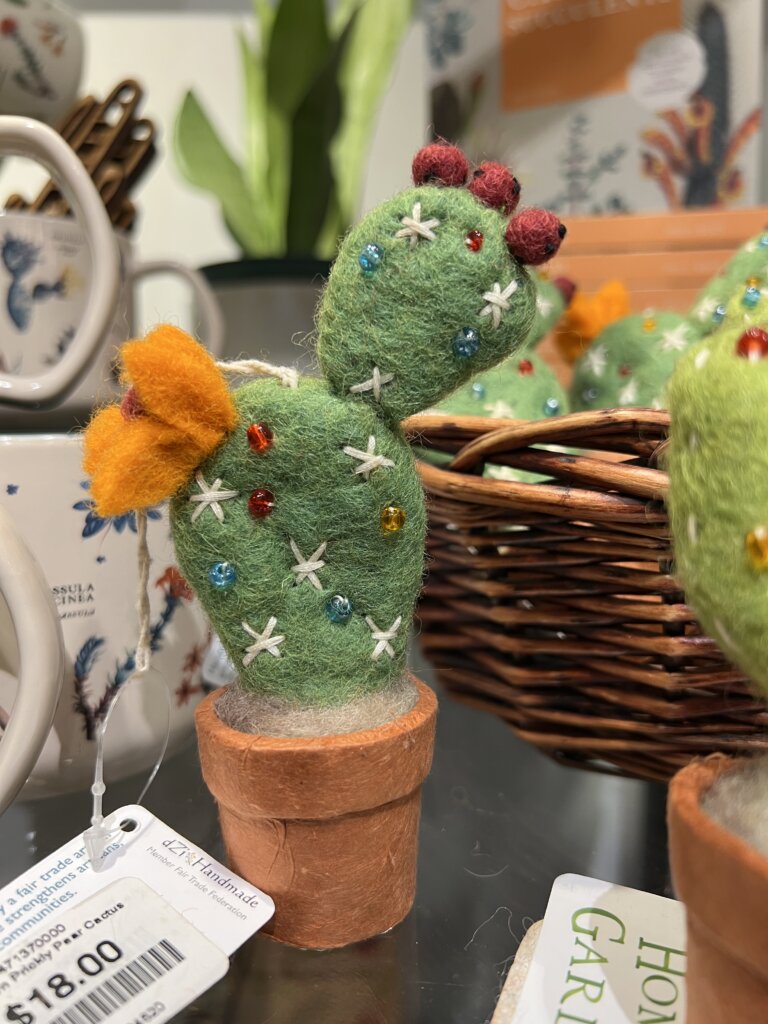
If you start not-collecting chickens, you’ll see them everywhere. Sometimes you’ll even notice something that looks like a chicken, and you’ll take a photo, then you’ll realize that it wasn’t actually a chicken. It was just a vaguely chicken-shaped item, or something that looked like a chicken because of a shadow. When that happened to us a few times, we decided to make it okay to not-collect not-chickens too. After all, why waste a perfectly good chicken-ish photo? Here is an example of a not-chicken:
Meijer Gardens says this is a prickly pear cactus. It’s also a not-chicken.
Not not-collecting turkeys
Sometimes, when we’re out not-collecting chickens, we notice that there are a lot of turkeys. This happens often in the weeks leading up to Thanksgiving, but sometimes at other times of the year too. Larry is always very sad to find turkeys, because we’re not not-collecting turkeys.
Poor Larry, outside Third Coast Bakery in Traverse City. We’ve never seen a chicken there.
Thank you to everyone who’s joined in the fun!
We’re genuinely thankful to everyone who’s joined us in not-collecting chickens, and celebrating Chicken Tuesday with us each week! If you’ve shared photos of your chickens, or crocheted a chicken, or sent us pictures of chickens that you’ve managed to not-collect on your travels – thank you! We couldn’t do this without you! Well, okay, we probably could. Yes, we still would. It wouldn’t be as much fun, though!
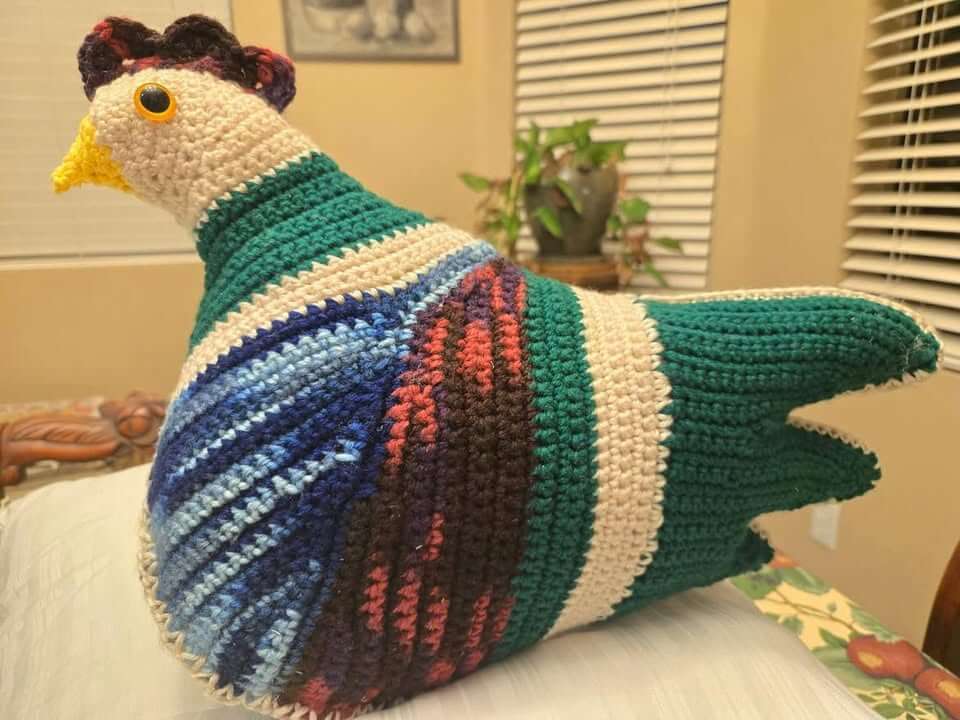
An Emotional Support Chicken, beautifully made by Debbie’s cousin, who has crochet skills
“Come, Thou Almighty King, Help us Thy name to sing; Help us to praise: Father, all glorious, O’er all victorious, Come, and reign over us, Ancient of Days.“
Come, Thou Almighty King is sung to the hymn tune ITALIAN HYMN. We’ve had an 8-bell arrangement of this for some years now, but this new arrangement is a “surprisingly easy” version. We recommend our Surprisingly Easy™ arrangements for quartets in particular. When there are four ringers, it helps when there are fewer sixteenth notes, and straightforward rhythms. These arrangements can also be helpful for groups of 2-4 ringers to put together without needing a lot of rehearsal time.
Here’s our demonstration video of Come, Thou Almighty King:
More information about this 8-bell arrangement
Sheet music for Come, Thou Almighty King is available to purchase and download from Choraegus.
Purchasing this arrangement gives you permission to print and maintain up to four copies for your handbell group. Please don’t pay for more copies than you need to! Purchase also gives you permission to use this piece in online and live-streamed worship services. See our licensing agreement for full details, and please remember to mention the title (Come, Thou Almighty King) and arranger of the piece (Larry Sue) on video-sharing sites and social media.
Please note that our music is designed to be downloaded as PDFs, so you’ll be responsible for printing your own music, and you won’t receive anything in the mail.
If you haven’t purchased music online from Choraegus before, you might like to look at our step-by-step guide. We designed this with pictures, to help you navigate the purchase and download process in a stress-free way.
Other arrangements of Come, Thou Almighty King
As well as the two 8-bell arrangements (Standard and Surprisingly Easy), we also have a 16-bell arrangement of this hymn, available to download from Choraegus.
Any questions?
If you have any questions about our music, we recommend reading our Frequently-Asked Questions. If you don’t find the answers you need, please contact us, and we’ll be happy to help!
Come, Thou Fount of Every Blessing has been one of our favorite 8-bell arrangements over the years, ever since we played it at an event in downtown Holland, and a group of local college students stopped to listen, and started singing along. This new arrangement of the NETTLETON hymn tune has fewer sixteenth notes than our standard version, and is more straightforward to play.
We recommend our Surprisingly Easy™ arrangements for quartets in particular. When there are four ringers, it helps when there are fewer sixteenth notes! These arrangements can also be helpful for groups of 2-4 ringers to put together without needing a lot of rehearsal time.
Sheet music for Come, Thou Fount of Every Blessing is available to purchase and download from Choraegus.
Purchasing this arrangement gives you permission to print and maintain up to four copies for your handbell group. Please don’t pay for more copies than you need to! Purchase also gives you permission to use this piece in online and live-streamed worship services. See our licensing agreement for full details, and please remember to mention the title (Come, Thou Fount of Every Blessing) and arranger of the piece (Larry Sue) on video-sharing sites and social media.
Please note that our music is designed to be downloaded as PDFs, so you’ll be responsible for printing your own music, and you won’t receive anything in the mail.
If you haven’t purchased music online from Choraegus before, you might like to look at our step-by-step guide. We designed this with pictures, to help you navigate the purchase and download process in a stress-free way.
Other arrangements of Come, Thou Fount of Every Blessing
As well as the two 8-bell arrangements (Standard and Surprisingly Easy), we also have a 12-bell arrangement of this hymn, and an arrangement for 2 octaves. All are available from Choraegus.
Any questions?
If you have any questions about our music, we recommend reading our Frequently-Asked Questions. If you don’t find the answers you need, please contact us, and we’ll be happy to help!
Asturias(Leyenda) was written by Spanish composer and pianist Isaac Albéniz in 1892. At the time it was written, it was simply called Prelude, as the first movement of a three-movement suite Chants d-Espagne. It was written for piano, but became one of the most important works in the classical guitar repertoire, and we recommend listening to Andrés Segovia’s transcription, if you haven’t already!
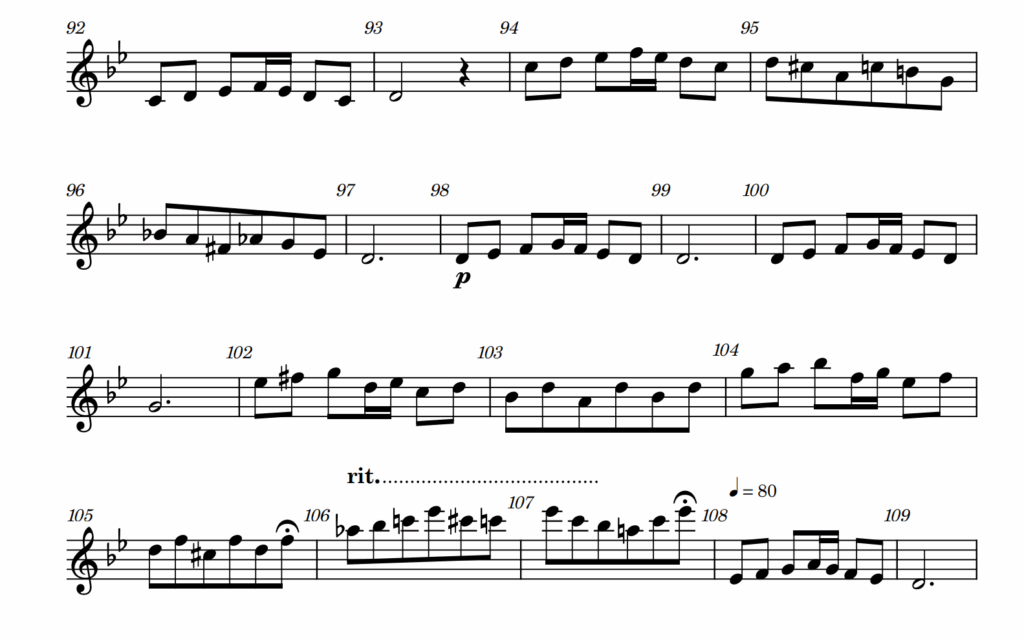
Asturias is full of drama, with intricate melodies and sudden dynamic changes. It presents an exciting challenge for the solo handbell ringer!
The first performance of this arrangement of Asturias (Leyenda) was by internationally acclaimed handbell soloist Emily Li, at the 2025 Handbell Musicians of America Pinnacle event in Wichita, Kansas. We’re looking forward to receiving a video of Emily’s performance to share here, but in the meantime, here’s an mp3 to give you an idea:
Some of the challenges involved in this arrangement
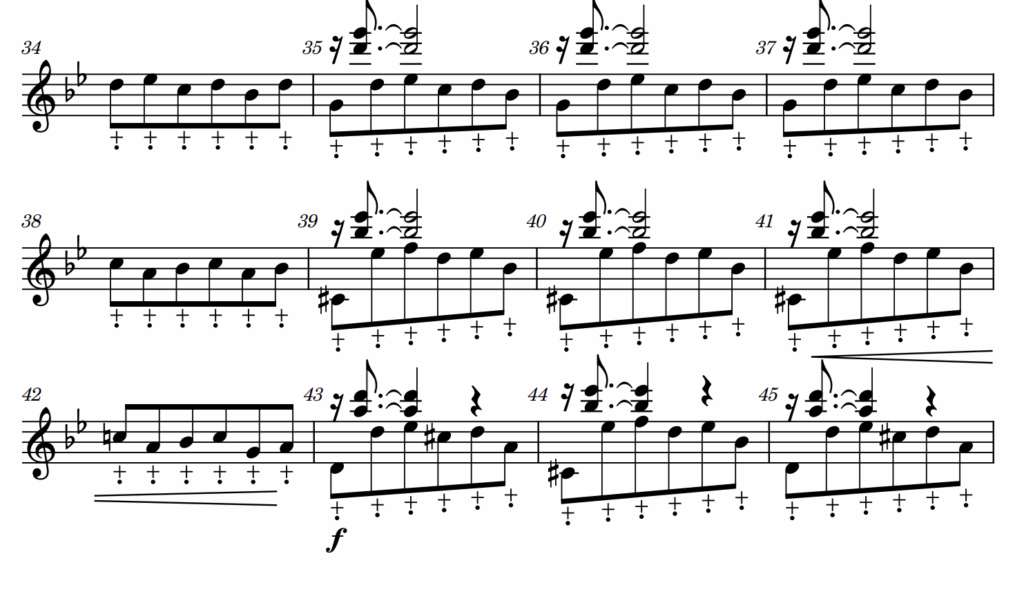
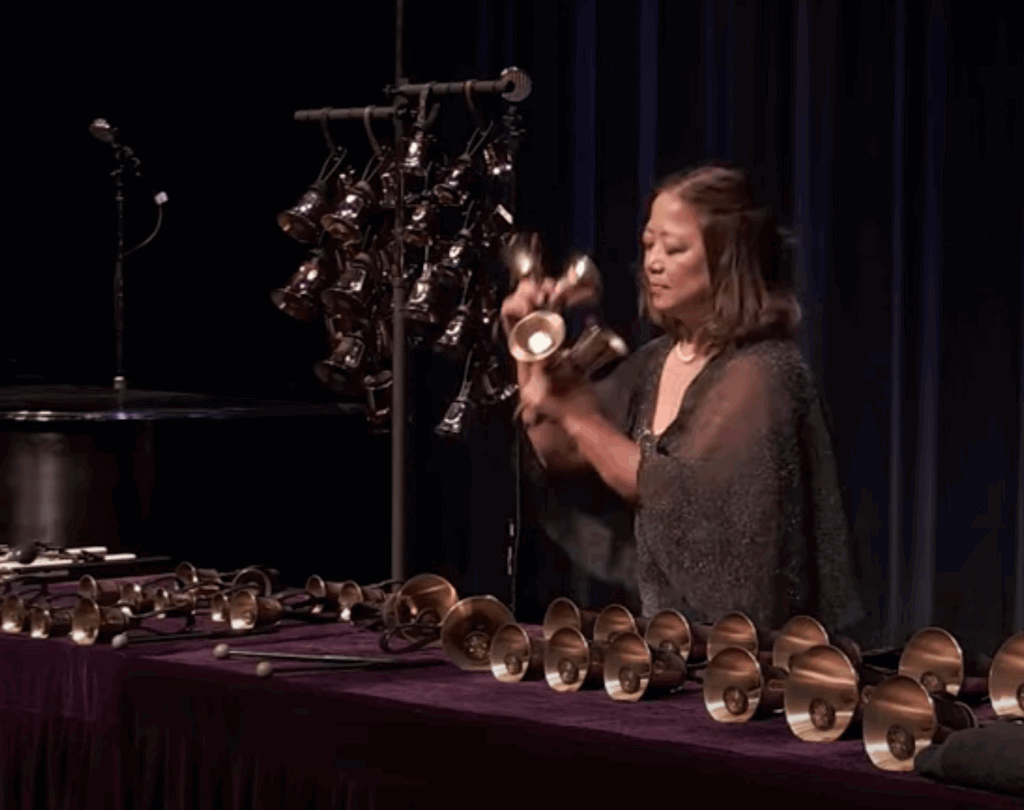
This handbell solo arrangement is a challenging one! The tempo is 132, so there’s the raw speed to consider. You could slow it down slightly, of course, and it would still be an impressive piece. Combined techniques are needed, played simultaneously at high tempo. Emily played double mallets with one hand, and switched between one pair of bells and another, in the other hand, at the same time:
There are extensive legato passages requiring traveling four-in-hand:
The piano accompaniment is a challenge too! Lois Leong played beautifully for Emily Li’s solo concert, but (in case you don’t have a Lois of your own) an mp3 piano accompaniment track is available. This can be used for rehearsal or as a backing track for a performance.
We’ve included two versions of the arrangement in the score package. One is the original version, as performed by Emily Li at Pinnacle. The other is a slightly modified version that’s had a few of the challenges removed and is perhaps slightly easier to play. It still has plenty of challenges for the advanced soloist, though!
The bells needed for this arrangement are: A4-G7 for the original version, and A4-D7 for the slightly modified version.
If you’d like to play Asturias…
The score for Asturias (Leyenda) is available to download from Choraegus.
If you have questions…
If there’s anything more you’d like to know about this handbell solo, you’re welcome to contact us. Larry will be happy to answer your questions!
Emily Li performing Asturias at Pinnacle 2025 (you’ll have to trust us, as there’s no audio here)
“All to Jesus I surrender, All to Him I freely give; I will ever love and trust Him, In His presence daily live. I surrender all, I surrender all; All to Thee, my blessed Savior, I surrender all.”.
Our new arrangement of the popular hymn I Surrender All uses just 8 handbells, and can be played by 2-4 ringers. The tune is SURRENDER, a 19th-century melody composed by Winfield S. Weeden.
More information about this 8-bell arrangement
Sheet music for I Surrender All is available to purchase and download from Choraegus.
Purchasing this arrangement gives you permission to print and maintain up to four copies for your handbell group. Please don’t pay for more copies than you need to! Purchase also gives you permission to use this piece in online and live-streamed worship services. See our licensing agreement for full details, and please remember to mention the title (I Surrender All) and arranger of the piece (Larry Sue) on video-sharing sites and social media.
Please note that our music is designed to be downloaded as PDFs, so you’ll be responsible for printing your own music, and you won’t receive anything in the mail.
If you haven’t purchased music online from Choraegus before, you might like to look at our step-by-step guide. We designed this with pictures, to help you navigate the purchase and download process in a stress-free way.
Any questions?
If you have any questions about our music, please start by reading our Frequently-Asked Questions. If you don’t find the answers you need, please contact us, and we’ll be happy to help!
Beloved Friend was written in memory of Bernie Foulk, who was a member of Kalamazoo Ringers from 2022 to 2025. We all loved Bernie, and his love for the earth, people, all of nature, music, and (of course) his wife Jackie, who joined Kalamazoo Ringers with him. We’d all hoped to have many more years of ringing with Bernie, but that was not to be. After a short illness, Bernie headed for the next life, and we started missing the kindness, personality and humor that he brought to rehearsals.
Larry wrote this original composition in memory of Bernie, and every note has a special meaning that he explains in the introduction to the score. This original composition came together in time for the Kalamazoo Ringers to play it for the first time in their 2025 spring concerts. The group only had a couple of rehearsals to read through it, but it turned out to be a very special (if emotional) tribute to Bernie.
In Bernie’s memory, all proceeds from sales of this work will be donated to the Kalamazoo Ringers.
More information about Beloved Friend
Beloved Friend is for 3-7 octaves of handbells. It’s a Level 3 arrangement, and the score is available to purchase and download from Choraegus. You can either purchase an individual copy (useful for massed ringing events, or for preview), or purchase the full choir license. Please note that Choraegus handbell music is designed to come to you as a downloadable PDF file. You’ll be responsible for printing your own music, and you won’t receive anything in the mail. If you haven’t purchased music online from Choraegus before, we recommend our step-by-step guide. We designed this guide to help you navigate the purchase and download process in a (we hope!) stress-free way.
Your purchase of the full-choir license allows you to perform, broadcast and live-stream this piece as part of a concert or worship service. There’s no need for any additional license or fee. We askthat youcredit the composer (Larry Sue) and publisher (Choraegus) in any printed media such as concert programs, and online (in video descriptions). Please see our licensing agreement for full details.
We appreciate your help in spreading the word about Choraegus handbell music. If you record a video of your group playing any of our pieces, we’d love to see it. You’re welcome to share it with us by email or on our Facebook page!
Any questions?
If you have any questions about our music, please start by reading our Frequently-Asked Questions. If someone has asked us a question even once, it will be there, along with the answer. Please contact us if you don’t find the information you need, and we’ll be happy to help.
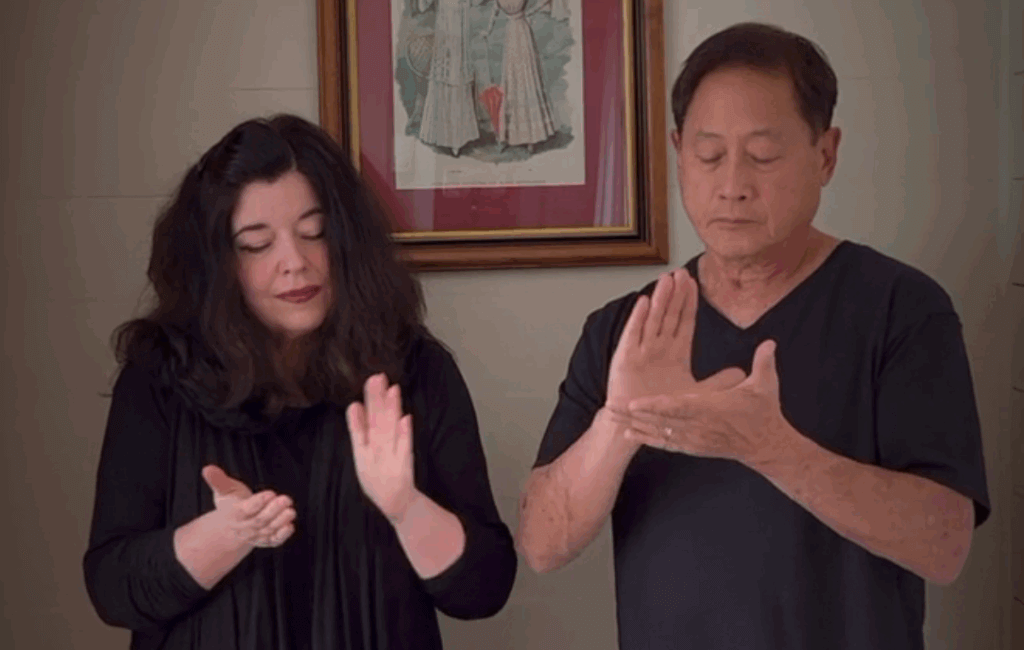
American composer Steve Reich wrote Clapping Music in 1972. It’s a minimalist piece that uses no instruments, and is performed entirely by clapping. We’d never heard of this piece until a couple of weeks ago, when we received an email from a friend, asking if we’d learn it to play at her late husband’s memorial service in Kalamazoo. He was also our friend, of course, and we were honored to be asked to do this.
We found videos of various people and groups performing this piece, and our first thought was: “Wait. We play handbells, not percussion. Can we even do this?”. We downloaded the score, and decided to have a go, but told our friend not to put it into the order of service quite yet, just in case! We really wanted to be able to do it, though, knowing how much her husband loved the piece.
How Clapping Music is constructed
Clapping Music starts with both performers clapping a basic rhythm (a variation on an African bell pattern) in unison. One performer continues clapping that rhythm all through the piece. After a certain number of measures (twelve, in the original score), the other performer claps the same rhythm pattern, but shifts ahead by one eighth note, skipping one note or rest in the rhythm and adding it to the end, in a continuous rotating of the pattern. The “skipping ahead/rotation” process continues, until eventually the pattern has come full circle. At that point, if all has gone to plan, the two performers are clapping in unison again.
This piece proved to be an interesting challenge for us. The first decision to make was which of us would play the continuous pattern, and who would play the “skipping ahead” rhythm. We opted to have Larry keep to the original pattern, and Carla to do the changing one. Both parts have their challenges. It may seem easy for the one person who keeps the steady rhythm throughout, but there’s the potential to be distracted by the other person. It takes concentration and focus, to keep playing the same thing, emphasising only the first beat of each measure, and not to be led astray by anything else you hear!
For the second person, the challenge is in making the quick changes, especially as some measures require clapping on the first beat, and others have a sneaky rest there. The tempo must be constant, of course. If anyone speeds up or slows down, the whole thing falls apart very quickly. Yes, we’re talking from experience! We started at a slightly slower tempo than indicated on the score, and had a lot of “oops” moments as we gradually started to understand more about how to make this piece work.
Stepping (well, clapping) out of our comfort zone!
We were surprised how much physical and mental effort it takes to play this piece. The original score calls for twelve repeats of every measure, but (after checking that we wouldn’t be the first to do it) we cut that down to four repeats, and that helped a lot. We read that the performers should try to match their sound as far as possible. We probably did a better job of that at the service than in the video we made afterwards. Having worried about sweaty palms on a hot day in church, they actually seemed to help, somehow. Unfortunately, we couldn’t replicate that when we clapped the piece again in our northern Michigan cottage!
We usually play handbell duets, so this felt like something that was far outside our comfort zone. We enjoyed the challenge, though, and plan to keep working on it! It might even be an interesting addition to our concert repertoire. If you book us for a handbell duet performance and you’d like to hear it, please let us know!
Clapping Music was very well received at our friend’s memorial service. We thought we’d make a recording to share, if only to prove that we did it. We encourage you to try it too!